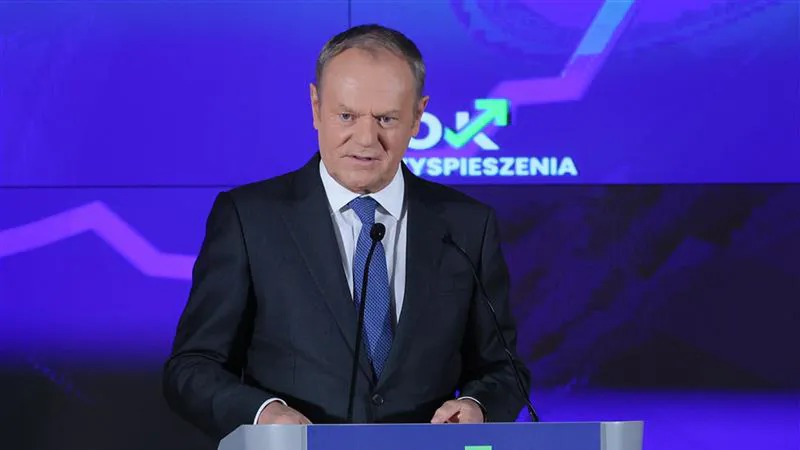
On 18 February 2026, in a highly anticipated return to the Giełda Papierów Wartościowych (Warsaw Stock Exchange), Poland’s Prime Minister Donald Tusk once again stood before business leaders, investors, and the press to outline his government’s economic strategy for the year ahead. Nearly one year after declaring 2025 a “Year of Breakthrough” for the Polish economy, Tusk joined forces with Finance Minister Andrzej Domański to proclaim 2026 the “Year of Turbo Acceleration.” This bold framing underscores a renewed push for investment‑led growth and the consolidation of Poland’s role as a dynamic economic force in Europe.
A Rallying Cry for Growth: From Breakthrough to Acceleration
In his opening remarks at the Warsaw Stock Exchange — the symbolic heart of Poland’s financial markets — Prime Minister Tusk reflected on the progress made since last year’s economic conference. In February 2025, he had called 2025 a year of transformation and increased investment, a prediction that, according to official economic data, largely came true. Poland achieved a 3.6% GDP growth rate in 2025 — one of the strongest in the European Union — despite global economic uncertainty and geopolitical pressure from neighboring conflicts. Tusk described this performance as proof that Poland has become “a haven of stability and growth.”
Now, with these results in hand, he stated with renewed confidence that 2026 will not just continue the momentum, but will amplify it. His characterization of this phase as “turbo acceleration” signals a strategic shift from recovery to proactive expansion.
Investment: The Heart of the Turbo Strategy
Central to Tusk’s economic thesis for 2026 is the belief that investment is the engine of growth. Both public and private investment initiatives will drive the acceleration he envisions. During the conference, Finance Minister Andrzej Domański presented a detailed outline of state spending plans, indicating that the government intends to allocate nearly PLN 280 billion to investment projects in 2026. This includes:
-
Defense and national security initiatives (~PLN 200 billion),
-
Major infrastructure projects (roads, urban development),
-
Environmental protection programs,
-
The first **nuclear power plant construction funding,
-
Expansion of rail networks and maritime economy support.
Tusk himself highlighted that while investment growth in 2025 was modest, projected investment spending in 2026 is expected to rise by around 10%, fueled by both state measures and increased foreign direct investment. This, he argued, would have a multiplying effect on broader economic activity.
A significant component of this strategy is the expansion of innovation‑enabling sectors, such as technology and science, as well as strengthening Poland’s start‑up ecosystem. Tusk emphasized that sustainable acceleration depends not just on traditional finance, but on fostering technological competitiveness and cutting‑edge domestic innovation.
Economic Confidence Amid Geopolitical Tension
One of the most consistent themes in Tusk’s speech was his emphasis on Poland’s economic stability despite a challenging international environment. With ongoing military conflict nearby and persistent geopolitical uncertainty, many European economies have experienced sluggish performance, currency volatility, or capital flight. Tusk used this backdrop to paint Poland as an exception — a country whose macroeconomic fundamentals have remained robust and attractive to investors.
He pointed to:
-
Strong GDP growth in 2025,
-
Low unemployment levels,
-
Stable inflation, and
-
A strong Polish złoty — factors that, in his view, make Poland an attractive destination for both domestic and foreign investors.
This narrative serves a dual purpose: it bolsters confidence among economic actors and reinforces Poland’s image abroad as a leader among mid‑sized European economies. According to official commentary from government sources, Poland has now entered the ranks of the world’s top 20 economies, further validating Tusk’s optimistic outlook.